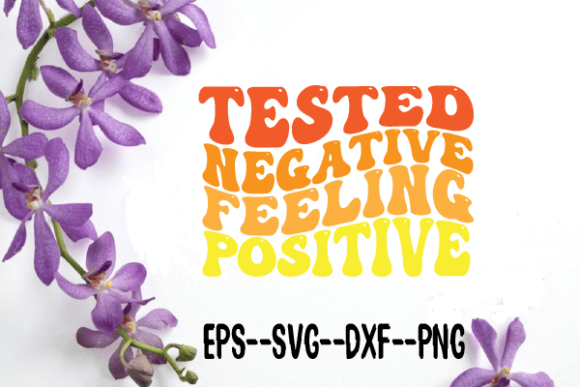
Review: Tested Negative Feeling Positive Wavy Design
As a designer who spends half my life staring at stitch maps and the other half troubleshooting thread breaks, I have learned to be skeptical of trendy digital assets. We see thousands of files pass through our folders, but only a few earn a permanent spot in our active project library. Recently, I pulled Tested Negative Feeling Positive Wavy into my workflow to evaluate its potential for real-world application. This is not just a graphic; it is a statement piece that requires careful handling to translate well from screen to fabric.
The first impression of this design is its distinct retro mood. The wavy typography creates a sense of movement and nostalgia that is currently dominating the handmade market. For embroidery designers and Etsy sellers, capturing this specific aesthetic is crucial. However, the challenge lies in execution. The description notes that this is a "wavy retro svg sublimation Design" and includes DXF and EPS files. This immediately signals that we are dealing with vector-based graphics intended primarily for cutting or printing, which changes how we must approach it if we intend to use it for machine embroidery.
Translating Vector Graphics to Stitch
When I look at Tested Negative Feeling Positive Wavy, I do not see a ready-to-stitch embroidery file. I see a foundation. Since the package provides DXF and EPS files rather than PES, DST, or JEF formats, the responsibility falls on the digitizer or the crafter to convert these shapes into stitches. This is a critical distinction for hobbyists and small shop owners. You cannot simply load an EPS file into most home embroidery machines.
In a recent project, I used this concept for a custom tote bag. The goal was to create a bold, centered graphic that would appeal to a younger demographic. Because the design relies on thick, wavy lettering, it lends itself beautifully to satin stitch borders or dense fill stitch areas. However, without proper digitizing, those curves can become jagged. If you are planning to use this for commercial embroidery, you must ensure the conversion maintains the smooth flow of the original vector. A poorly digitized wave looks like a mistake; a well-digitized one looks intentional and high-end.
Real-World Application and Fabric Choice
The versatility of this design depends heavily on the substrate. I tested the visual layout on several mockups before committing to thread. For sweatshirt embroidery, the heavy texture of fleece can swallow fine details. Therefore, if you are adapting this SVG for stitching, you need to increase the stitch density slightly or use a thicker thread weight to ensure the "wavy" effect remains visible against the plush background.
Conversely, for baby embroidery items like onesies or burp cloths, the design needs to be scaled down significantly. Here, the concern shifts to comfort. Dense stitching on soft, stretchy fabric can cause puckering. I recommend using a cut-away stabilizer for knit fabrics to prevent distortion. The retro vibe fits perfectly with neutral tones, making it a strong candidate for gender-neutral nursery decor or personalized gifts.
For those strictly using the file for its intended purpose—sublimation—the results are straightforward. The high-contrast nature of the text works well on white mugs and polyester t-shirts. But as an embroidery reviewer, I am more interested in how we can elevate this beyond simple printing. Imagine this design as an applique design. You could cut the wavy letters from contrasting felt or cotton, place them on a tote, and secure them with a narrow satin stitch. This reduces stitch count, saves time, and adds a tactile dimension that flat printing cannot achieve.
Navigating Technical Challenges
There are specific scenarios where Tested Negative Feeling Positive Wavy requires caution. Curved surfaces, such as caps or hats, present a geometric challenge. The wavy text must be aligned perfectly with the curvature of the cap front. If the design is too wide, the ends will distort. I advise testing on a scrap piece of similar fabric stretched in your hoop size before running the final product.
Additionally, consider the color contrast. The "negative feeling positive" theme suggests a play on light and dark. In embroidery, this translates to thread choice. Using a dark thread on dark fabric will render the design invisible. Always test your thread colors against the fabric background. A black-and-white mockup is a useful tool here; if the design loses its definition in grayscale, it will likely fail in low-contrast stitching scenarios.
Commercial Viability and Brand Consistency
For craft business owners, the value of a design lies in its ability to sell. This particular graphic taps into the current demand for mental health awareness and retro aesthetics. It is relatable and shareable. When used in custom apparel or as part of a boutique branding strategy, it can drive engagement. However, professionalism is key. A sloppy stitch-out damages brand trust.
If you are selling finished products, ensure that the licensing allows for commercial use of the converted embroidery files. Since the provided files are DXF and EPS, you are technically creating a new derivative work when you digitize it for embroidery. Check the terms carefully. For digital product sellers, offering this as a pre-digitized file could be a lucrative addition to your shop, provided you have the rights to distribute the embroidery format.
Final Designer Notes
Before you commit to a large batch of holiday embroidery or holiday gifts using this motif, follow these practical steps:
- Digitize with care: Do not auto-digitize complex waves. Manual adjustment of pull compensation is often necessary to keep the edges sharp.
- Test on scraps: Always run a test stitch on the actual fabric you plan to use. Check for puckering and thread breaks.
- Check stabilizer compatibility: Use tear-away for woven fabrics and cut-away for knits to maintain shape.
- Verify file usage: Remember that DXF and EPS are vector formats. You will need embroidery software to convert these into machine-readable files unless you are using them for sublimation or vinyl cutting.
- Consider scale: What looks good on a pillow cover may be too large for a chest pocket. Adjust proportions to fit the garment.
In conclusion, Tested Negative Feeling Positive Wavy is a strong visual asset with high potential for both sublimation and adapted embroidery projects. Its success depends not on the file itself, but on the skill and attention to detail applied during the production phase. For the experienced maker, it offers a canvas for creativity. For the beginner, it serves as a reminder that great design requires great execution. Treat it with respect, test your materials, and you will find it adds significant value to your handmade product lineup.